
The Boogeyman Was Compaq
Every industry gets better, faster and cheaper. Wealth management fees have not moved in fifteen years. Here is why — and what one lean firm is doing about it.
I was hiking recently with an old friend who had been at Dell in the early years, when it was mostly a warehouse in North Austin. I asked her the question you always want to ask someone who was in the room: who were you actually afraid of?
She didn’t hesitate. In 1989, she said, the boogeyman was Compaq.
The fear was reasonable. Compaq had gone from nothing in 1982 to $2.1 billion in sales by 1988, faster than any startup before it, and landed at 157 on the Fortune 500. Dell’s revenue that year was $258 million. Compaq was eight times its size, and the trade press was calling it the next IBM.
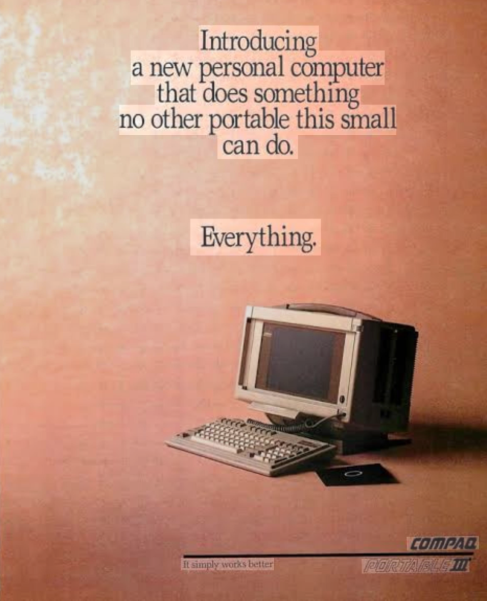
The one I remember is the Compaq Portable III. It had a handle on top, like a toolbox, because you needed one.
Compaq Portable III
Announced 1987 — state of the art
Twenty pounds, five thousand dollars, no battery. That was the state of the art, and people were proud to own one.
You know how it ends. Dell won on cost structure: direct sales, no dealer margin, no channel inventory, operating costs about half a traditional PC seller’s. HP bought Compaq in 2002 and retired the brand. The phone in your pocket outruns every computer Compaq shipped in 1989.
That is the arc of innovation, and it runs one direction: better, faster, cheaper. Not one of the three. All three, until what was extraordinary becomes ordinary.
My industry did not get the memo
I have spent nearly forty years in this business and seen it from both sides: the last eleven as owner of Keel Wealth, the years before that as a wirehouse financial advisor, inside the cost structure I am about to describe. Over that stretch the cost of nearly everything a client touches has collapsed. Everything except the part I am responsible for.
The median advisory fee has been one percent on the first million dollars since 2009, and Kitces Research puts it at one percent today.
Set that against what happened underneath us. Charles Schwab took commissions apart after the SEC deregulated them in 1975. Jack Bogle launched the first index fund in 1976 and was ridiculed for it. Between them, the average equity fund investor went from 1.04% in 1996 to 0.40% last year, and index funds now average five basis points.
The raw material got ninety-five percent cheaper. The advice fee did not move.
Why not
The easy answer is that nobody kills a golden goose. True, but the honest version is more interesting.
Wealth management is a layered business and every layer costs money. Teams, with salaries and benefits. Offices, usually the nice kind. Travel. Compliance. Marketing. And the big one hiding in plain sight: paying somebody else to manage the money. Much of what the industry calls wealth management is the assembly of other people’s products, each with its own fee.
Stack that up and one percent is not greed. It is arithmetic. The fee is what the structure costs.
The trouble is the structure stopped evolving. The business became stale, slow, and — measured against the rest of the economy — expensive.
It is not comfortable to say that about your own cohort. Schwab took real abuse for it; Bogle was called worse. But the consumer deserves a clear-eyed opinion from someone on the inside. Wealth management is not bad. It does offer value, and most people in it are honest. It could simply be better, far more transparent, and meaningfully cheaper.
Why the incumbents can’t fix it
You cannot innovate your way out of an embedded cost structure with a memo.
If I had a team of people with families depending on me — mortgages, tuition, health insurance — I would tell you your fee was stuck where it is. I would not lay off good people to shave twenty basis points, and you would not want to work with someone who would. That is why large firms cannot follow the arc even when they see it.
I do not have a payroll
Plenty of people in this business have told me that operating solo is a fool’s errand. I will never scale. Clients don’t want their eggs in one basket, and I am the basket. There is no succession plan. I have heard all of it from people I respect.
What the argument misses is that leanness is now a capability, not a limitation. The tools available to one practitioner are extraordinary, and I can deploy them without adding meaningful cost.
Schwab holds every client’s assets and provides the trading, research and technology; trust attorneys and accountants come in on the specific problem; Advent Black Diamond handles the reporting; and a team of artificial intelligence agents — three analysts, a technician, a skeptic, a tax optimizer and a gatekeeper — does the daily grind.
The agents work around the clock, don’t get sick, and never take a day off. They are dispassionate in a way no human analyst has managed, and they accept criticism without ego.
What they are not is in charge. Not one can place a trade. They do the grinding — reading, sorting, arguing, checking — and hand me the work. I decide what we accept and what we reject.
Who this is for
There is a real answer on the other side. For some people the traditional wealth manager is exactly right — the team, the office, the reassurance of an institution. I do not begrudge anyone who wants it. You have to sleep at night, and if the current model lets you do that, it is the correct model for you.
But if you are your own boss when it comes to your portfolio — if you would rather help prepare the meal than be served — if you are curious enough to want to know what makes the clock tick rather than just read the hands, then we really need to talk.
I will take you behind the curtain and show you how wealth management actually works. Not pie charts: a real risk-and-reward discussion. We will talk about your family, and not just about them but with them. We will whiteboard the problem and work out a solution together — built around you, with nothing to sell you and no third party paying me. Not a cookie-cutter model tweaked to look like it was made for you.
Before you decide anything, ask what weight you are dragging around, and what it is costing your financial future over the next twenty years.
You may find you are carrying a Compaq while an iPhone sits on the table in front of you.
Let’s have the conversation
Thirty minutes, no presentation, no pie charts. Bring your actual situation and we will look at it together.
Call (512) 368-4593 Email Scott
If someone came to mind while you were reading — a colleague, a friend, a family member quietly wondering whether they are getting their money’s worth — I would be grateful for the introduction. Referrals from people who already know how I work built this firm, and they remain the best clients I have.
Sources
Kitces Research on Advisor Productivity (2025); Cerulli Associates advisor survey (2025); FA Insight advisory fee benchmarking; Investment Company Institute, Trends in the Expenses and Fees of Funds (2025). Compaq and Dell financial figures from contemporaneous reporting; Portable III specifications and list price from period product documentation; inflation adjustment via CPI.
Disclosures
This article is for informational purposes and is not investment advice or an offer to sell any security. Investing involves risk, including risk of loss. Keel Wealth Management, LLC is a registered investment adviser. Client assets are held at Charles Schwab & Co., Inc., which is not affiliated with Keel Wealth Management and does not endorse or recommend any adviser. References to third-party service providers do not constitute endorsements by those providers.
The Compaq Portable III advertisement is reproduced for historical commentary. Compaq and Portable III are trademarks of their respective owners. Keel Wealth Management is not affiliated with, sponsored by or endorsed by HP Inc., Dell Technologies, Apple Inc. or any company named in this article.